Sunday, July 14, 2013

Play,

Today there is new fiber play, Bear gifted me a vintage loomette for my birthday - so I have been playing. Like any new toy there is the initial flush of interest - which in this case resulted in a mini blanket. I've also finished Bears new hat, a redux of Hope he never needs this in exactly the same yarns. Bears new job requires more site visits so a safety hat seemed called for - to go with the safety vest. Photos will be made once Bear is home wearing the hat. Till then you just have my word.
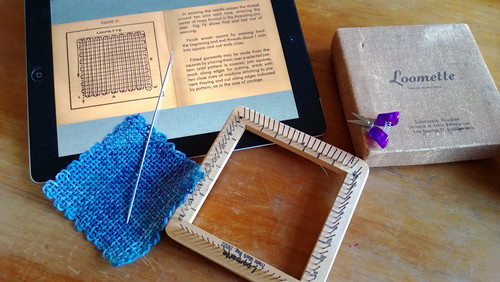
The loomette is great fun, you may have seen an article in Piecework April/May 2010 or come across the website Eloomanation, which provides more details and detailed scans of the original instructions. My loomette is in nice condition, no rust, original box but no needle or instructions. Instructions are easy to find at Eloomanation or on you tube, and 6" blunt needles at Lacis. I was up and weaving easily. Of course it was the fourth or fifth square before I remembered the warping pattern without needing to reference the instructions. It's not as simple as a set of yarns laid across each other, there are three layers of yarns In a highly specific order, if done right one ends up weaving every second weft, not every weft.
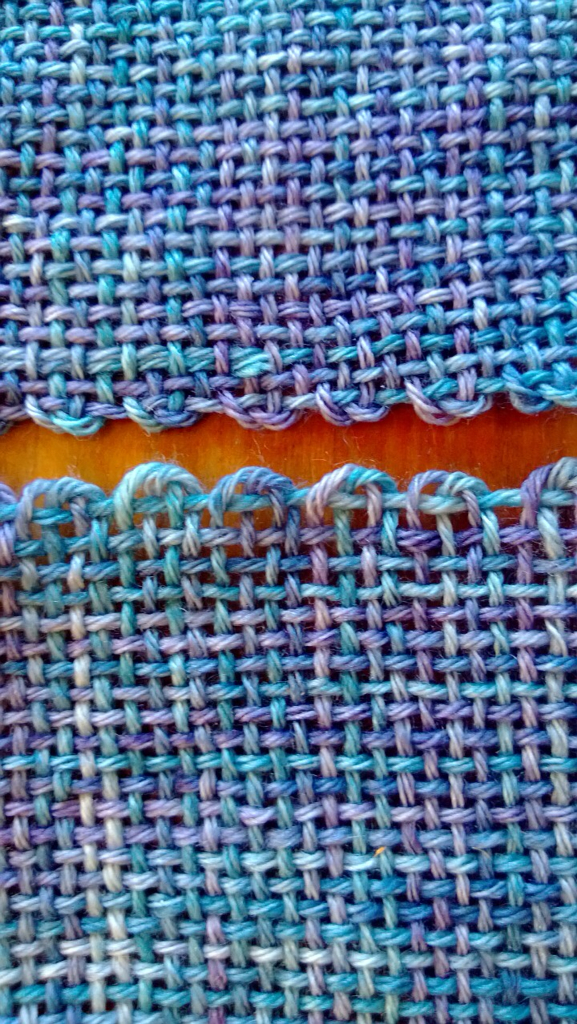
I used vintage Purls sock yarn left overs from a recent project, and was surprised to see how open the weave was, and how much it closed when the squares were wet blocked. I have grid weaving on a rigid heddle loom, and on a four shaft table loom ... And I liked it. But found that I liked to touch the yarn more than one gets to in weaving. With the mini loom and sewing the weft yarns into place the yarn is touched and felt ... Not as much fun as knitting, but something I'm keen to explore over time.
All in all I made 16 squares with a plain weave, and another two with "fancy" weaves. Then I stitched them together, not using the method in the original instruction book but using a modified mattress stitch from the Eloomanation site.
Excuse the crumpled sample, it has been spending time in the bottom of my knit basket, I love this fabric, its lite and drapes well. The weave is open -but that is why it drapes so well. The seams leave a lot to be desired, I see why many people use crotchet to join the squares, what you can't hide emphasize.
What I don't understand is why this would have been promoted as a way to make garments ... Blankets, table linen, household cloths yes ... Skirts and jackets no. I guess my modern aesthetic is different to that of the early 20th century, or perhaps promoting was one thing, adoption of the ideas that were promoted another. Just like today's weird craft advts that try to sell ugly outcomes for valid materials and methods.
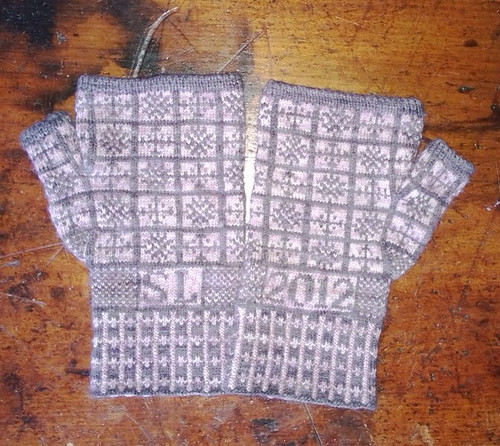
And finally a photo of the finished Sanquhar mitts, there is value in dating ones work. But these were started early 2012 and finished mid 2013 ... So the date seems optimistic to say the least.
I've got a wee backlog of projects to share, some baby mittens, and the frog pond socks, rather than make this post long I might try updates more frequently.
Take care, na Stella.

Saturday, July 06, 2013

The big reveal....

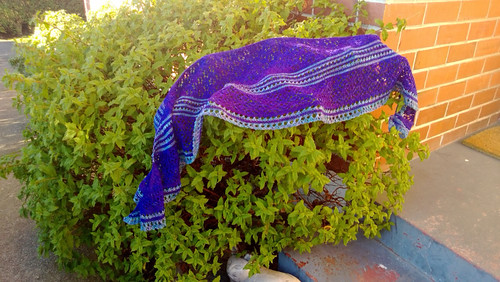
Last night was swap night, and yet again there were amazing things unveiled. My swap was for Katya, some of who's work is on show here. Her sense of colour and texture are amazing, and when I read she loved jewel colours I stash dived and then ravelery dived. Katya dosnt have a big presence on ravelry, so I was a little bit on my own ... but went looking for something that was jewel like, and reflected her love of texture, beads and her amazing garden - without bring cluttered and ott. A little ott can be good, but too much is well .... too much.
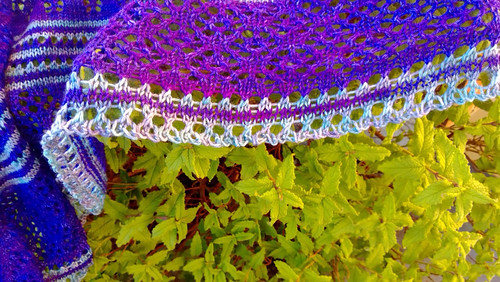
I found Daizies, by Marisa Hernandez, a two tone shawl knit long and narrow. I loved the two lace patterns in this shawl, both highly structured, just as I like my decoration. My only worry was how well I could follow the instructions and if any mistakes would show.
The shaping of the shawl was new for me, with six stitches increased every right side row, three at each end. These increases make for a dramatically long and narrow shape, and the beautiful charts were all sorted ready to work with the ev increasing stitches. While the repeats were often only four or eight rows, the charts were divided up and shown for every stitch count as the shawl grew. It was amazing and simple at the same time.
I love the result that the rapid increases gave. The ends fall in a beautiful cascade, a ripple, or waterfall zig zagging back and forth - some times spiraling. And the two colours enhance the effect.
The edge finish was also new to me, but I'm a novice at lace shawls and lace shawl bind offs. It is a stretch bind off, with a yarn over and purl one, before two stitches are slipped over the third. The effect was of a mini icord, a two stitch one, and the purl bump pushed the edge to the right side. When blocked with wires woven through the edge looks like a twisted chain along the length.
The yarn is vintage Purls sock yarn, in two different colour ways both with undercurrents of purple, I don't have the details to hand but will fill in soon ....promise.
Take care and an update on what my swap partner made me in the next post
Na stella

Sunday, June 30, 2013

Plodding along

Its winter, no we haven't had any more snow, just wet and cold with good sharp frosts, but the days are short. We have turned the corner into longer days, more light in the morning and more light in the evening. Within a few weeks we will drive to work/school at 8am and we won't have to turn house lights off as we leave, and car lights on as we drive. I can't wait. Ditto driving home. Teaching bookbinding went well, as always three week intensive blocks are - well intensive, but fun, such fun sharing a love and interest with others.
So knitting, well .. I could show you but then I'd have to ....we all can imagine how that ends, in spy stories there is a threat to kill, in secret knit swaps ... I'm not sure what the threat is, to cut or tangle ones yarn, to steal ones placeholder on the pattern chart, to randomly knit increases in your project whilst you are not looking? To swop out the chart, yarn, needles for something that will cause problems.
Yes, I've been plodding along on my secret swap knit, at times having serious doubts about the colour (I think these colours are *** colours, what if my swap partner doesn't think they are?), and the pattern (I can't remember if I've ever seen them use one of these - is that because they don't, or because they don't have one?).
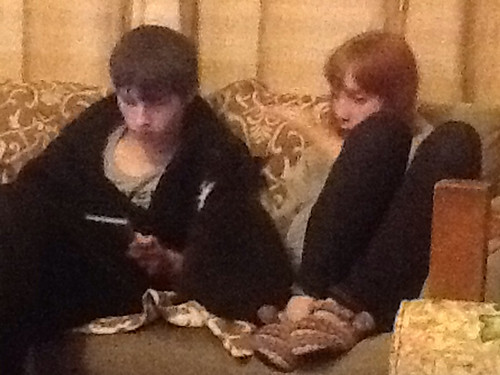
Meanwhile I can share what the cubs are up to, all three, eldest, youngest and the cat all tucked up on the sofa on a cold winters eve. Sorry for the blurry faces, the wont keep still and one is fuzzy by nature. It was dark outside so artificial light. And yes little cub is wearing pink fake fair isle slippers, described by bear as ugly, don't worry I didn't make them, we bought them in a discount store.
Take care, news of things knitting soon, I promise,
Na Stella

Sunday, June 16, 2013

My knitting was pushed aside this week,

In favor of books, bookbinding. So today I thought I would distract you all with images of the most recent, and the most challenging. That way you might not notice the lack of knitting content, then again ... given the title of the blog that may be a little optimistic.
When ever I'd Google for bookbinding information, especially for tutorials I'd find many many well put together and informative tutorials and helpful sites. Bookbinders seem akin to knitters, with a willingness to share that can only be called generous. Amongst the information I found there were almost always references to a binding called secret Belgian binding. At first I ignored those posts, the clearest instructions seemed rather confusing ... Diagrams showing many holes and a complex stitching path. So I found other bindings to practice. I bought bookbinding books. Then this week one of my students asked if I knew about the secret Belgian binding, and as a class we had one of those conversations about how nothing on the Internet should really be called secret. After that I thought I really should look more at what was so special about the binding ... And maybe even play a little with it.
I dug a little deeper, well rather I read all the posts I had ignored about the SBB, and found out why it was held in high regard by so many. I also found that the binding had another name, the criss-cross binding, and a few storys that explain different origins here & here. All in all the book seemed to have some clear benefits, pages that lay open flat, a spine as flexible as a Coptic bound book but all covered and protected with a hard spine. So I thought I would try to follow the instructions. It wasn't hard, just detailed, fiddly at times, and I found that I had to read the instructions and follow them - not anticipate the next stage. I was glad I had a few dozen books of different types experience before I started this one.
So I started, and committed to making an A4 book, folded from a brand new pad of quality A3 art paper (expensive!) and covered in bookcloth (also expensive - usually I restrict bookcloth to the spine to make my meager stash last longer). This is the equivalent of casting on with the best yarn in the stash. But unlike knitting, some of the materials can't be unravelled and returned to a neat and ready state if it all goes wrong.
I made the covers and prepared the pages, and then strung the covers together, in this binding the covers consist of a front and back board with a separate spine board. Holes are punched near the hinge edges of the front and back cover boards. The cover is assembled by lacing the spine between the front and back covers. One of those trickier to start, and tricker to explain but actually quite straightforward when underway processes. With the cover assembled the signatures - that would be sets of pages, are stitched inplace. In this binding the signatures are stitched to the lacing that holds the covers together.
I usually find curved needles tricky to use, I can't seem to predict where the point will go and find them much trickier to manipulate than straight needles, they rotate in my fingers and point in odd directions, but for this work I needed a curved needle. The shape was perfect for threading the signature threads under the cover threads. I laced the cover with dark navy and sewed the signatures with white thread.
Here is the book all complete, cover closed and neat. Now I understand the process I would make changes next time. Firstly I would punch with a much smaller hole, and I would use much thicker binding cord. This is ok, but thicker cord would make the binding more visable, more dramatic. I was worried about making the holes too small to pass a needle and thread through three times, which is what is done in this binding. Turns out with this size thread I could have had much smaller holes. Next time I will swatch the thread and hole size before I committ to punching the holes in the covers.
This is the interior view, see how nicely the pages lay open, partly because they are super thick 200gsm Fabrino recycled artists paper. Mostly because of the way the binding hinges each set of pages off a very flexible cord arrangement.
Below shows the rather neat first page view, how the pages meet the covers ... I like this very much. This book took much of today to make, mostly as I didn't know what I was building up to. I think this is a much more time consuming bind than the saddle stitched, Coptic or tapped signatures - and one I will work again. I think for me this may become my sketch book binding. But then again I'm just a learner ... At the start of a journey and I imagine there are many many more binding options for me to discover and explore.
Na Stella,
Take care